The world presses in · El mundo nos alcanza
Places of Becoming · September 2026
Engineering Maleness.
Digital Colonialism and the Campaign for Wellness and Ecological Purity
The rise of the man who eats correctly, worships correctly, fathers correctly, and votes correctly.

A few days ago, another infographic found me. Spiral notebook aesthetic, hand-drawn icons, a title like a study guide: The Evening Wine Habit. It walked through what one or two glasses supposedly does to sleep, cortisol, liver, brain, gut, then offered a five-minute daily lesson plan to fix me. I drink a glass of wine most evenings with my wife, watching something together over a cheese table after the day empties out. It is not a compulsion. It is closer to a couple's liturgy.
As I usually do with food data, I looked into the science behind the infographic. Most of what it claimed was accurate, if stretched — real research on sleep architecture and cortisol, generalized from studies of heavier or disordered drinking to any evening glass at all.1 The “91 percent of users cut back” statistic turned out to be the company's own marketing figure, not an independently verified finding.2 It was, in other words, a sales funnel wearing a lab coat. This is now a generational market moment.
It was, in other words, a sales funnel wearing a lab coat.
What stayed with me wasn't the wine. It was the shape of the thing. I started noticing the same shape everywhere — in “seed oil” panic, in raw milk enthusiasm, in warnings about the plastics supposedly lowering testosterone, in a wave of young men reportedly returning to church at rates their sisters are leaving it. Different content, same architecture. I want to name what I think that architecture is.
Four currents, one direction
Start with religion. Gallup's tracking shows the share of young men who say religion is “very important” in their lives rising from 28 to 42 percent in two years—the first time in twenty-five years of data that young men have surpassed young women on this measure.3 PRRI's research complicates any celebration a pastor might take from that: among Gen Z men who attend church regularly, 52 percent endorse traditional gender roles and 45 percent endorse some version of the “great replacement” conspiracy theory.4 Using different survey measures, PRRI finds no broad male revival: young men's disaffiliation has leveled off while young women's has continued to rise.5 This is not simply revival. It may not be revival at all, so much as revival's rumor doing real ideological work regardless.
Then the politics. A 2026 global survey by Ipsos and the Global Institute for Women's Leadership at King's College London, covering 23,268 people across 29 countries, found that 31 percent of Gen Z men now agree a wife should always obey her husband, compared with 13 percent of Baby Boomer men.6 A 2024 Ipsos study found 60 percent of Gen Z men believe efforts toward women's equality have gone far enough to discriminate against men, against 40 percent of Gen Z women who say the same — a 20-point gap wider than in any older generation.7 This is not an American export running downhill to the rest of the world. It is happening in enough countries, for locally specific reasons, that we should resist the easy story where the United States sneezes and the planet catches a cold.
Then the food and the body. The MAHA movement — seed oils bad, raw milk good, pharmaceutical companies suspect — reads as freshly right-coded, but commentators tracking its growth trace much of its constituency back to what one recent piece called the “traditionally liberal, 1970s natural food movement.”8 An idea can change political address without changing its content. And running alongside it, a masculinity-specific version: real, published research on declining sperm counts and endocrine disruption gets picked up and amplified into something closer to a horror story. One recent column describes industrial modernity as engaged in “forced chemical castration” of American men, with plastics, soy, and seed oils recast as agents of decline.9
What connects them

I have spent recent years working out a framework I call the colonial algorithm of humanity — fourteen traits a refreshed imperial logic uses to sort the fully human from the merely tolerated subhuman: male, white, North Atlantic, learned, cisgender, married, fertile, Western Christian, traditional, capitalist, able-bodied, adult, productive, documented.10 Meet enough of them and you are legible as Optimus (winner). Fall short and you become Infimus (loser) — available for exclusion, extraction, or worse. Four mechanisms keep the sorting running: a cultural supremacy that supplies the ideology, an intellectual imperialism that supplies the knowledge, an institutional rule that supplies the enforcement, a political conformity that supplies the policy.
Before adding a fifteenth trait, one already on that list needs an update: learned. In the older imperial register, learned meant lettered-city credentialing — the scribe, the printed canon, the university degree, what Ángel Rama called la ciudad letrada, the site where colonial authority in the Americas was administered through writing itself.11 A newer version now fused to the same figure runs on the opposite premise: credentials read as institutional and captured, even feminized, while hustle, risk, and self-branding read as the real proof of mind — Foucault's entrepreneur of himself, the neoliberal subject who legitimates through the market rather than the academy.12 The figure I'm describing doesn't choose between these two versions of learned. He runs both at once, claiming ancient religious and national authority through one register while claiming the disruptive glamour of the platform economy through the other, and neither side is ever required to answer to the other.
I think what these four currents are building, together, is a fifteenth trait. Call it wellness and ecological purity. It is not the same as the old category of able-bodiedness, which was a status you simply had or lacked. This is a practice — a diet, a supplement stack, a posture of suspicion toward the modern food system — that has to be performed and re-performed to count. That distinction matters, because a status you're born with can't be marketed. A practice that has to be renewed daily is exactly the kind of thing an algorithm is built to sell you, one infographic at a time.
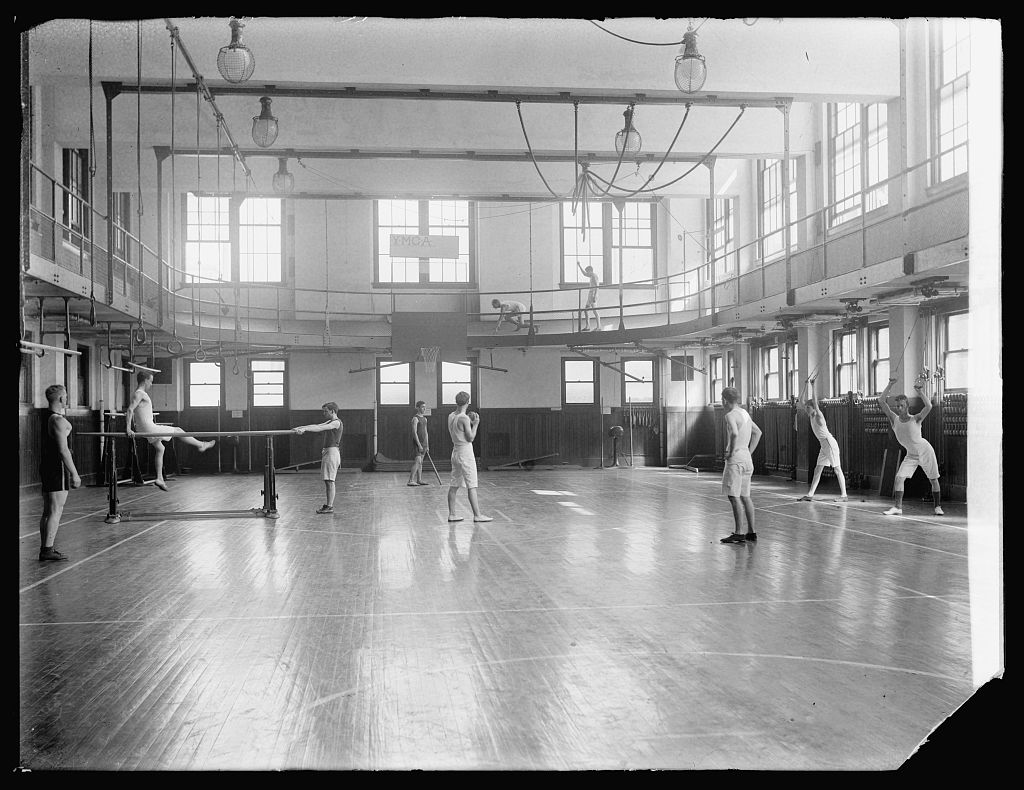
Put the four currents in the same frame and a figure starts to assemble itself: disciplined, eco-conscious, biologically vigorous, faithful, family-headed, patriotic, generationally rooted — the man who eats correctly, worships correctly, fathers correctly, and votes correctly, all as expressions of the same underlying virtue. There is a nineteenth-century name for an earlier version of this figure: Muscular Christianity, the movement whose YMCA gymnasiums gave the world basketball and volleyball, and whose leading voice, Theodore Roosevelt, wrote The Strenuous Life, fusing bodily discipline with national and religious destiny long before anyone had heard of seed oils.13 The new version is faster, more granular, and algorithmically distributed rather than preached from a single pulpit, but the blueprint is not new.
A figure starts to assemble itself: disciplined, faithful, biologically vigorous, and politically legible.
It is tempting to call this manufactured male figure an Übermensch, and there is something to the comparison — the self-overcoming, the will to discipline, the disdain for whatever is soft or compromised. But Nietzsche's Übermensch was explicitly post-Christian, a figure who invents his own values precisely by discarding what Nietzsche called herd morality, Christian submission chief among it.14 What is being engineered now runs the opposite direction — Nietzsche's ideal possessed by religion: willpower and self-mastery re-yoked to obedience, headship, and national belonging. Not a man beyond good and evil. A man beyond suspicion — because he has performed enough purity, in enough categories, to have earned it.
The engine underneath

I don't think fear is one sociopolitical ingredient in this among others. I think it is the operating system.15 What every version of this figure promises, at bottom, is the same offer Babel made in Genesis 11 — safety through sameness, one language, one wall, one diet, one flag, in exchange for never having to sit with the discomfort of a world that doesn't sort itself so cleanly. The infrastructure has changed. Pulpit and pamphlet have given way to the feed. Fit, intermittently fasted, bearded, seed-oil-free, sexually vigorous for the Lord, educationally minimal, entrepreneurially ambitious, stewarding the flag, and protecting the tribe. The offer has not.
I don't have a tidy resolution for this, and I'm suspicious of pieces that manufacture one. What I have instead is a wine glass most evenings, next to my wife, unbothered by an algorithm's opinion of my liver — a small, stubborn refusal to let a purity test — dressed up as ideology, muscular Christianity, or a fifteenth box on someone else's Optimus checklist — decide what my evenings are for. Maybe that's not nothing. Maybe the first move against an engineered man is simply declining to audition for the part.
Chicago notes
Notes and sources
- Katie S. McCullar et al., “Altered Sleep Architecture Following Consecutive Nights of Presleep Alcohol,” Sleep 47, no. 4 (2024): zsae003, https://doi.org/10.1093/sleep/zsae003. See also George F. Koob and Ian M. Colrain, “Alcohol Use Disorder and Sleep Disturbances: A Feed-Forward Allostatic Framework,” Neuropsychopharmacology 45, no. 1 (2020): 141–65, https://doi.org/10.1038/s41386-019-0446-0.
- Reframe (Glucobit, Inc.), “Reframe: Cut Back on Alcohol,” accessed September 7, 2026, https://www.joinreframeapp.com. The company reports that 91 percent of users significantly reduce consumption within three months; the figure is company-reported and is not presented as the result of an independent peer-reviewed trial.
- Frank Newport and Lydia Saad, “Rise in Young Men’s Religiosity Realigns Gender Gaps,” Gallup, April 16, 2026, https://news.gallup.com/poll/708410/young-men-religious-gains-realign-gender-gap.aspx.
- Melissa Deckman, “The Complicated Truth Behind Gen Z’s ‘Religious Resurgence,’” The Hill, July 15, 2025, https://thehill.com/opinion/congress-blog/religious-rights/5399602-gen-z-men-religious-resurgence/.
- Public Religion Research Institute, “New PRRI Data Rebuts ‘Religious Revival’ Claims,” press release, April 15, 2026, https://prri.org/press-release/new-prri-data-rebuts-religious-revival-claims/; Bob Smietana, “Gen Z Women Are Losing Their Religion, New Study Finds,” Religion News Service, April 15, 2026, https://religionnews.com/2026/04/15/study-young-women-are-not-flocking-to-church-they-are-leaving/.
- Jordana Moser and Gideon Skinner, “Almost a Third of Gen Z Men Globally Agree a Wife Should Obey Her Husband,” Ipsos, March 5, 2026, https://www.ipsos.com/en-uk/almost-third-gen-z-men-globally-agree-wife-should-obey-husband.
- Olivia Ryan, “Millennials and Gen Z Less in Favor of Gender Equality Than Older Generations,” Ipsos, March 4, 2024, https://www.ipsos.com/en-us/millennials-and-gen-z-less-favour-gender-equality-older-generations.
- Hannah Holland, “The Make America Healthy Again Movement Is a Threat to Public Health,” MS NOW, January 5, 2025, https://www.ms.now/opinion/msnbc-opinion/rfk-jr-make-america-healthy-again-indoctrination-vaccines-rcna186046.
- Jared Whitley, “The Real Toxic Masculinity: The Hidden, Chemical Crisis Destroying American Manhood,” Townhall, March 28, 2026, https://townhall.com/columnists/jaredwhitley/2026/03/28/the-real-toxic-masculinity-the-hidden-chemical-crisis-destroying-american-manhood-n2673462. See also Óscar Fraile-Martínez, Miguel A. Ortega, and Cielo García-Montero, “Understanding the Secular Decline in Testosterone: Mechanisms, Consequences, and Clinical Perspectives,” International Journal of Molecular Sciences 27, no. 2 (2026): 692, https://doi.org/10.3390/ijms27020692.
- Oscar García-Johnson, Embracing Fear: Christian Re-Existence in the Trump Era (Eugene, OR: Cascade Books, 2025), chap. 1.
- Ángel Rama, The Lettered City, trans. John Charles Chasteen (Durham, NC: Duke University Press, 1996).
- Michel Foucault, The Birth of Biopolitics: Lectures at the Collège de France, 1978–1979, ed. Michel Senellart, trans. Graham Burchell (New York: Palgrave Macmillan, 2008).
- Clifford Putney, Muscular Christianity: Manhood and Sports in Protestant America, 1880–1920 (Cambridge, MA: Harvard University Press, 2001); Theodore Roosevelt, The Strenuous Life (New York: Century, 1901).
- Friedrich Nietzsche, Thus Spoke Zarathustra (1883–1885); On the Genealogy of Morality (1887).
- García-Johnson, Embracing Fear, introduction.